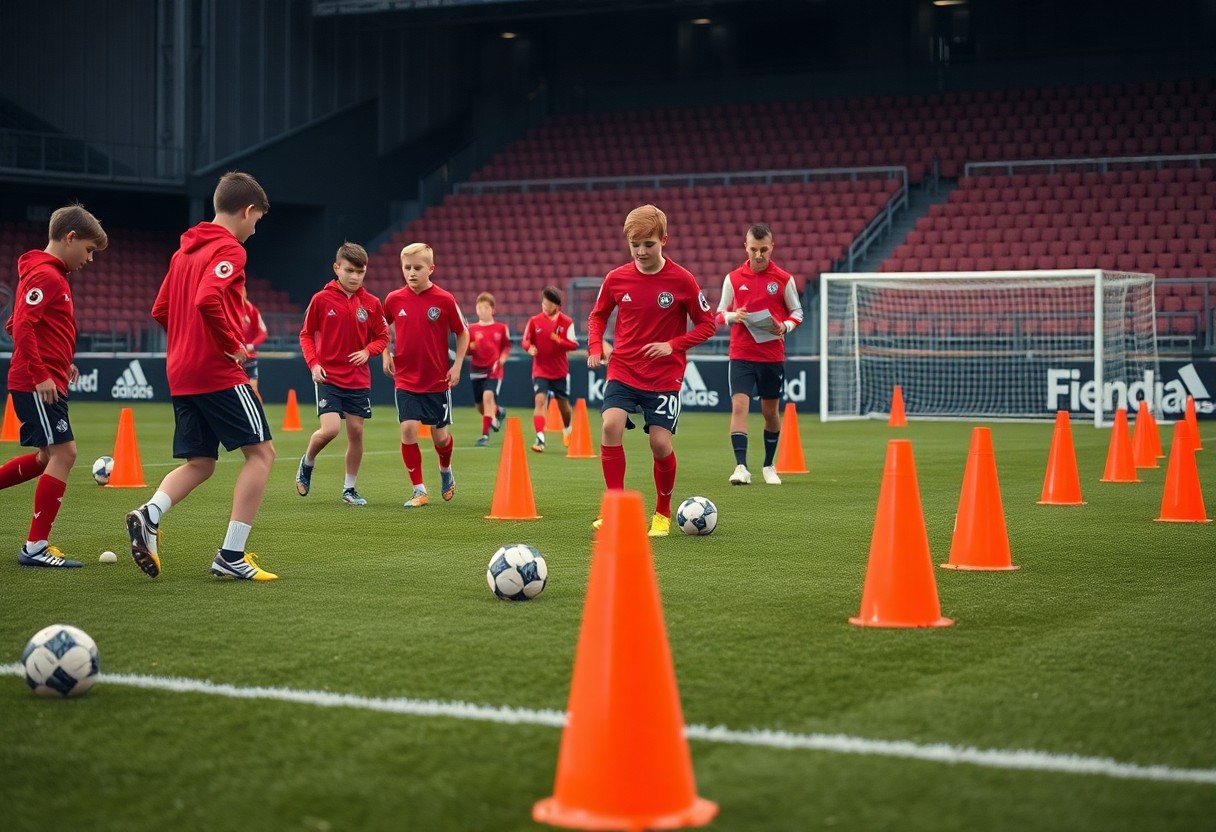
Football in Germany is built on elite youth academies and a structured pathway to professional football, combining tactical education, scouting and heavy club investment in coaching and facilities. The league’s willingness to give regular first‑team minutes to young players and its high‑intensity, physically demanding playing style accelerates development, while financial stability and integration with reserve teams create a reliable pipeline for producing world-class talent.
Types of Talent Development Programs
| Youth Academies | Club-run U8-U19 structures, e.g., FC Bayern and Borussia Dortmund, emphasizing technical curriculum and pathway to first team |
| Professional Training Camps | Short, intense blocks (typically 7-14 days) with 2 sessions/day, GPS load monitoring, tactical rehearsal and recovery protocols |
| Regional Talent Centers | DFB-affiliated hubs that widen scouting, run weekly sessions and feed academies across federal states |
| Dual-career Programs | Education and vocational support alongside football to reduce dropout and support long-term welfare |
| Loan & Partnership Networks | Strategic loans to 2. Bundesliga/3. Liga clubs to secure first-team minutes and accelerate development |
- Bundesliga academies
- Talent development centers
- Youth academies and reserve teams
- Professional training camps
- Loan pathways
Youth Academies
Clubs run structured cohorts from U8 to U19 with tailored curricula: technical drills, tactical periodization and age-specific strength work. FC Bayern’s system produced long-term starters like Thomas Müller, while Borussia Dortmund’s academy fast-tracked talents such as Jadon Sancho. Many academies field reserve sides for transition and use data to track playing minutes, match load and psychological tests to reduce dropout and optimize promotion rates.
Professional Training Camps
These blocks (commonly 7-14 days) compress conditioning, tactical installation and situational scrimmages; clubs schedule 1-2 intense sessions daily, GPS tracking and individualized recovery. RB Leipzig and Bayer Leverkusen routinely use camps to test U19 graduates in opponent-specific rehearsals, balancing load to limit injury risk while exposing players to senior-speed decision-making and set-piece roles.
Coaching staff often simulate match-week cycles: morning strength or aerobic work, afternoon tactical sessions, plus evening video and psychological briefings; sports scientists set thresholds-typically 90-120 minutes of high-intensity work per day-to monitor acute:chronic load ratios. Recognizing the gap between youth and senior demands, clubs use camps to assign targeted workloads, assess resilience under fatigue and make data-driven promotion or loan decisions.
Factors Contributing to Success
Germany’s system combines mandatory youth infrastructure under the DFL licensing with club-driven youth academies that prioritize game time and education; Borussia Dortmund and Bayern Munich routinely promote teenagers like Jadon Sancho and Jamal Musiala to first teams. Large crowds-averaging around 40,000 per match-raise intensity for developing players. Investment in scouting networks and holistic support (schooling, psychology) complements on-field training. Perceiving this integrated model as both structural and cultural clarifies how talent is repeatedly produced.
- youth academies
- DFL licensing
- talent ID
- coaching curriculum
- competitive minutes
- sports science
Competitive Environment
Young players face professional opposition early: the Bundesliga and 2. Bundesliga offer meaningful senior minutes and the A-Junioren Bundesliga provides national-level youth competition. Clubs use loan pathways and reserve matches to bridge ages 17-21-examples include Sancho’s rapid rise at Dortmund and Musiala’s early Bayern integration. Intense matchday atmospheres and promotion/relegation stakes accelerate tactical maturity and physical resilience, forcing teenagers to adapt faster than in many other European systems.
Coaching Philosophy
Coaching follows a unified, age-specific curriculum from U9 to U19, blending technical drills, positional principles and high-intensity pressing; the DFB’s education pipeline up to the UEFA Pro Licence ensures methodological consistency. Clubs prioritize small-sided games for decision-making and daily deliberate practice to build 1v1 skill, so academy players enter first-team setups with shared tactical language and match-readiness.
Further depth shows academies pairing on-pitch work with sports science: GPS tracking, video analysis and individualized load management are standard, while national scouting camps and the A-Junioren Bundesliga act as measurable talent pools. Psychological support and structured schooling reduce dropout rates, and regular first-team training stints let coaches benchmark progress. Together, these elements create reproducible pathways that convert technical prospects into adaptable professionals.
Step-by-Step Pathway to Pro Status
Pathway Breakdown
| Stage | What happens / Examples |
| Early development (U6-U12) | Local clubs teach technical basics, small-sided games and motor skills; many pros start here |
| Academy phase (U13-U16) | Clubs with a Nachwuchsleistungszentrum (NLZ) provide daily training, schooling and DFB talent camps |
| Youth professional (U17-U19) | Players compete in the U17/U19 Bundesliga, face national scouts, and sign first pro contracts |
| Transition (18-21) | Reserve teams in Regionalliga/3. Liga, targeted loans and first-team integration; examples include Sancho, Götze, Müller |
Early Identification of Talent
Scouts and club academies spot prospects as early as age 9-11 through regional trials and DFB feeder camps, using standardized tests for speed, ball mastery and decision-making. Clubs partner with schools to monitor growth and offer daily technical sessions, while standout players are fast-tracked into U13 squads; Dortmund and Bayern routinely recruit regional standouts into their NLZs before age 14.
Progression Through the Ranks
After identification, players move through age-group teams into the U17 and U19 Bundesliga where performance data and match minutes dictate promotion; coaches use individualized development plans that target tactical IQ, physical conditioning and position-specific skills. Many Bundesliga first-team debuts occur between 17-20 years, with clubs like Leverkusen and Dortmund promoting academy players straight into senior squads.
Clubs supplement academy matches with reserve-team competition in the Regionalliga or 3. Liga to expose teenagers to senior football, and routinely arrange loans to 2. Bundesliga sides for game time. Success stories-Jadon Sancho’s breakthrough at Dortmund, Thomas Müller’s seamless Bayern debut-illustrate how consistent minutes, tailored coaching and strategic loans create the final leap to regular top-flight football.
Pros and Cons of the Bundesliga Model
Pros and Cons
| Pros | Cons |
|---|---|
| Clear first‑team pathway – clubs like Borussia Dortmund regularly promote academy graduates into starting XI. | Early pressure – intense media and fan scrutiny can overwhelm teenagers stepping into senior football. |
| High‑quality coaching – licensed youth coaches and structured curricula improve technical development. | Burnout risk – heavy training loads and year‑round competition raise injury and fatigue chances. |
| Competitive minutes – Bundesliga gives young players genuine league and European exposure. | Transfer poaching – top talents are frequently snapped up by richer foreign clubs, disrupting progression. |
| Integrated education – many academies combine schooling with football, aiding long‑term prospects. | Limited safety net – players who don’t make it often face uncertain career alternatives. |
| Financial sustainability – selling developed players funds club reinvestment and stability. | Short‑termism – emphasis on quick sales can prioritize market value over holistic development. |
| Regional scouting network – broad club networks identify talent early across Germany and Europe. | High competition internally – depth in academies means many prospects never reach senior squads. |
| Mental and medical support – top clubs provide psychologists and sports science teams. | Physicality jump – adapting from youth to senior tempo increases injury and performance variability. |
| Pathway to national team – Bundesliga graduates frequently populate Germany youth and senior squads. | Expectation mismatch – early labels (e.g., “next big star”) can stall realistic development plans. |
Advantages of Youth Development
Clubs invest in long‑term talent pipelines, and that pays off: Borussia Dortmund and Schalke have produced first‑team starters and internationals through dedicated academies, while Bayern and RB Leipzig funnel resources into coaching and sports science; as a result, youngsters receive meaningful Bundesliga minutes, top‑level training, and often access to European competition before age 21, accelerating tactical maturity and market value.
Challenges Faced by Young Players
Adapting to senior football brings rapid increases in physicality, media attention, and expectation, and many teens face heightened injury and burnout risk; transfers to foreign leagues can offer money but disrupt development, as seen in several high‑profile early exits that stalled progress.
More specifically, balancing schooling, relocation, and intense training creates psychosocial strain-clubs now employ psychologists and individualized load management, yet inconsistent minutes, frequent coaching changes, and commercial pressures still leave some prospects without a stable pathway, increasing the probability they drop out of professional trajectories before age 23.
Tips for Aspiring Footballers
Refine daily on-ball fundamentals and game-speed decision making; German systems reward players who can press, pass and transition quickly.
- Youth academies: target U17/U19 squads and reserve teams in the Regionalliga for competitive minutes
- Technical training: dedicate 30-60 minutes daily to weak-foot and finishing drills
- Match exposure: secure trial weeks, showcase matches or loans to gain real minutes
Assume that consistent, measurable progress and networked exposure (trial weeks at clubs like Dortmund or Leipzig) accelerate professional opportunities.
Maximizing Opportunities in Youth Academies
Seek versatility by training multiple positions and attend at least one formal trial per season; clubs such as Borussia Dortmund and RB Leipzig often promote players from U17/U19 squads with many debuts occurring between ages 17-20. Use weekly GPS and video analysis to match academy KPIs, aim for 4-6 measurable improvements per month, and build strong relationships with academy coaches to convert training blocks into first-team minutes.
Building a Personal Development Plan
Create a written development plan with 3-5 monthly goals across technical, physical and tactical areas, schedule 10-14 training hours weekly including recovery, and track KPIs like pass completion, successful presses and 30m sprint time to monitor progress.
Break the plan into micro-cycles: set weekly targets (e.g., 200 ball touches, 3 finishing sessions, two strength sessions), conduct monthly reviews with video clips and GPS data, and adjust load to avoid injury by limiting high-intensity reps to two sessions per week. Include mental tasks-pressure simulations and decision-making drills-and document progression with numbers so coaches can validate readiness for higher-level trials or loans.
Comparison with Other Football Leagues
Comparison Overview
| Aspect | Bundesliga vs. Others |
|---|---|
| Development model | Earlier senior debuts and a higher share of youth minutes; clubs like Dortmund and Hoffenheim prioritize match exposure rather than long academy incubation. |
| Financial dynamics | Lower aggregate spending than the Premier League, but frequent profitable sales that fund reinvestment into youth systems. |
| Tactical focus | Emphasis on physical intensity and transitions, contrasting with La Liga’s possession training and the Premier League’s mixture of physicality and resources. |
| Case studies | Producing premium exits (e.g., Jadon Sancho → ~€85m) while maintaining high average attendance and steady developmental pathways. |
Bundesliga vs. Premier League
Germany delivers consistent first-team minutes to young players, often translating into high resale value, while the Premier League leverages immense financial muscle and global reach to attract talent. Dortmund’s elevation of prospects that later sell for large fees (Sancho for ~€85m) highlights a pathway focused on playing time; England frequently offers bigger wages and exposure but can limit minutes for emerging players amid intense squad competition.
Bundesliga vs. La Liga
Spanish academies like La Masia and Castilla emphasize technical and tactical refinement, producing elite ball-players; the Bundesliga complements that by accelerating physical and high-intensity match experience, giving youngsters more senior minutes earlier to build resilience and pressing acumen.
Spanish clubs often integrate youth via B teams and gradual elevation-Ansu Fati debuted at 16 and matured within Barcelona’s structure-whereas German sides regularly hand 18-20-year-olds sustained Bundesliga minutes. That divergence makes Germany a preferred environment for rapid professionalization, while Spain remains the benchmark for long-term technical schooling.
To wrap up
Considering all points, the Bundesliga’s blend of youth academies, coaching emphasis on tactical development, systematic scouting, regular first-team opportunities, and financial stability creates an ecosystem that grooms technically adept, mentally resilient players ready for top European competition.
FAQ
Q: How does the Bundesliga identify and nurture young players from grassroots to the first team?
A: Bundesliga clubs operate extensive youth academies and regional development centers aligned with DFL/DFB licensing standards. Players enter coordinated age-group programs that combine technical training, tactical education, physical conditioning and schooling. Club philosophies create clear pathways through U17/U19 sides and reserve teams, while regular competitive youth leagues and integrated friendly schedules accelerate match experience. Holistic support-sports science, nutrition, psychology and individualized development plans-ensures promising prospects are prepared physically and mentally for first-team demands.
Q: Why do Bundesliga clubs give young players more first-team opportunities than many other top leagues?
A: Financial prudence and club governance encourage promoting homegrown talent: the 50+1 model and sustainable-business emphasis reduce reliance on expensive transfers, so clubs develop internal assets. Coaches and sporting directors prioritize long-term planning and are more willing to rotate squads, test youngsters in cup and league fixtures, and fast-track high-performing prospects. Demonstrated success turning academy graduates into first-team contributors and transfer-market value reinforces this approach, creating a cycle where youth development is both a sporting and economic strategy.
Q: What coaching, scouting and infrastructure elements set Bundesliga talent production apart?
A: Bundesliga systems combine advanced coaching education, standardized training methodologies and state-of-the-art facilities. Clubs invest in data analysis, video feedback, individualized training loads and sports-science monitoring to optimize progression. Scouting emphasizes local networks, early identification and technical profiles suited to Bundesliga playing styles, while loan partnerships and reserve-team competition provide transitional steps. A club-wide playing philosophy-shared across youth and senior teams-develops tactical intelligence and positional versatility that prepares players to perform at elite levels.