How to frame the Haaland vs Messi conversation
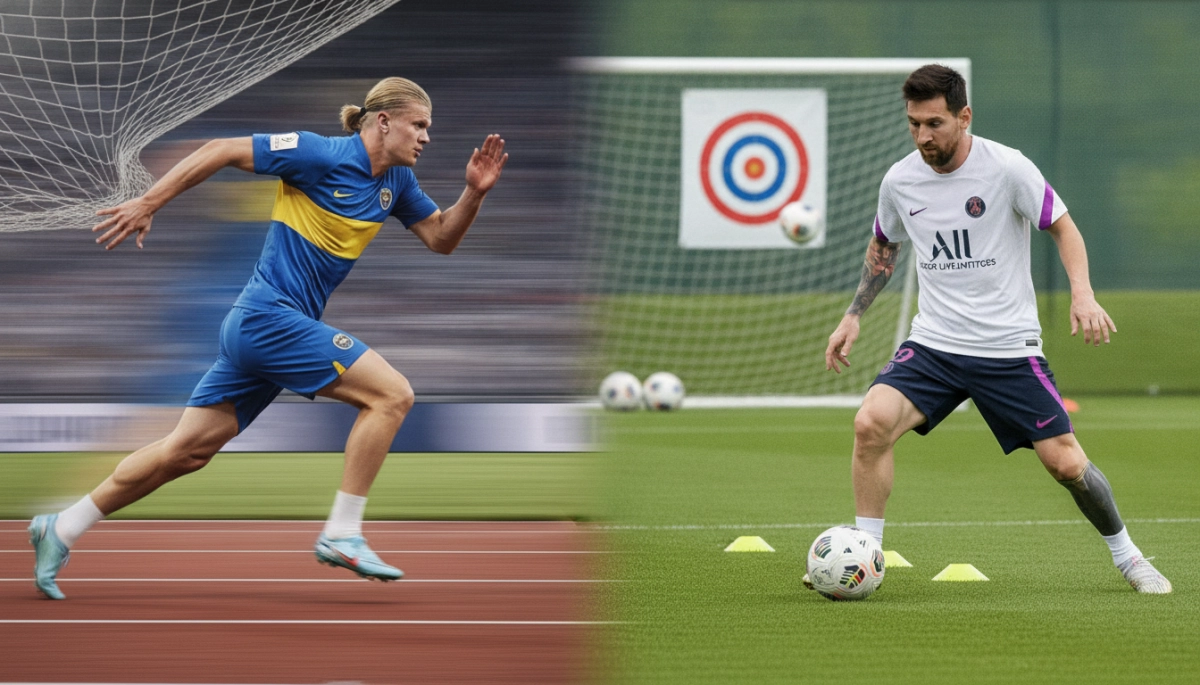
You’re about to compare two elite goalscorers who operate with very different tools. Erling Haaland and Lionel Messi occupy distinct tactical roles, physical profiles and career contexts, so any fair comparison starts by setting the right frame. Rather than asking who is “better” in absolute terms, you’ll get more insight by considering what each player brings to a team, how their physical attributes shape their actions on the pitch, and how their scoring methods differ.
Keep in mind three guiding points as you read on:
- Role matters: a center-forward’s job often contrasts with a false nine or playmaker.
- Context matters: team tactics, teammates and league styles shape opportunities.
- Metrics need interpretation: raw counts (goals, assists, sprints) tell part of the story; shot location, expected goals and build-up involvement complete it.
Different templates: position, movement and on-ball behavior
You’ll notice immediately that Haaland and Messi are built and used differently. Haaland is typically deployed as a classic striker: he occupies central channels, attacks the space behind defenders and finishes moves close to goal. Messi, especially across his prime years, operated in a fluid role—dropping deep, drifting wide and creating as much as finishing. That difference in deployment leads to distinctive patterns in touch locations, passing involvement and defensive responsibilities.
Haaland’s on-field profile
- Primarily a penalty box predator who times runs to exploit high defensive lines.
- Relies on physicality—height, strength and explosive acceleration—to win duels and hold up play.
- Finishes with a variety of strong, clinical strikes from close range and on the run.
Messi’s on-field profile
- Occupies pockets between midfield and attack, pulling defenders out of position.
- Combines low center of gravity, close control and vision to dribble through tight spaces and create chances.
- Scores from set pieces, long-range attempts and intricate combinations—often creating high-quality shots for himself and teammates.
Speed and physical traits: how they shape scoring opportunities
Speed is one of the most obvious contrasts. Haaland pairs a high top sprint speed with a powerful stride that lets him burst past defenders and convert fast breaks. Messi is quicker over short distances in tight spaces—his acceleration, change of direction and balance let you see him evade markers rather than outrun them in a straight line.
The practical effect: Haaland generates many of his chances by getting behind defenses and finishing high-value opportunities inside the box. Messi generates chances by manipulating space, drawing multiple defenders and producing high-quality shots and through-balls. Understanding these mechanics helps you interpret their goal tallies: similar totals can mask very different processes that lead to scoring.
Next, you’ll examine finishing efficiency, shot locations and data that quantify how each player converts chances under different tactical systems.
Finishing efficiency, shot locations and what the data says
When you dig into shot maps and advanced metrics, the differences become concrete. Haaland’s profile shows a concentration of attempts from the central penalty area, often within the six-yard box or on the move from low-angle breakaways. That kind of proximity produces a high expected-goals-per-shot (xG/shot) because the chances are inherently higher quality. Messi’s shot map, by contrast, is more dispersed: a mix of long-range efforts, angled finishes from the edge of the box, set-piece attempts and opportunistic close-range strikes created by his own dribbling or combination play. The result is a lower average xG per shot for Messi, but also a larger share of shots that come from crafted, high-difficulty situations.
Conversion rate alone doesn’t settle the debate. Haaland often posts strong conversion rates because he takes fewer low-probability shots; many attempts are high-percentage tap-ins or headers. Messi’s raw conversion can look similar or even better in some seasons because of his extraordinary finishing craft—he consistently turns low-xG shots into goals through placement, curl and timing. But if you remove penalties and account for shot location, Haaland’s scoring looks more volume-driven and location-optimized, while Messi’s reflects skill in creating and finishing from lower-probability positions.
Contextual metrics matter too. Non-penalty xG (npxG) and goals over/under expectation highlight different strengths: Haaland tends to outperform xG by accumulating quality central chances and finishing them clinically; Messi often outperforms by producing high-value, low-xG goals through technique and set pieces. Interpreting these numbers means acknowledging sample sizes, the role of penalties and how a player’s assigned role affects where and how often they shoot.
How teammates and tactics amplify (or limit) each scorer
No striker or playmaker operates in a vacuum. Haaland’s output is amplified by systems that supply direct, vertical service—quick transitions, overlapping fullbacks and wingers who either pull defenders wide or deliver early crosses. Teams that press high and force turnovers also create the kind of fast breaks where Haaland’s straight-line speed and power convert into clear chances. Put simply: give him frequent, central opportunities and he will usually convert at an elite rate.
Messi’s productivity, by contrast, is more dependent on creative freedom and a midfield willing to combine in tight spaces. He thrives when the structure permits roaming—receiving between the lines, initiating overloads and recycling possession into pockets. Teammates who understand his tendencies (timed runs behind defenders, short quick passes, decoy movements) increase the quantity and quality of his chances. In teams that demand a fixed positional role, Messi’s influence on scoring tends to drop, but his overall creative impact often remains high.
Finally, tactical balance matters: a team built to maximize Haaland might sacrifice midfield control for direct forward momentum; a Messi-centric side may cede some directness for superior chance construction. Both approaches are valid and successful in different environments. Understanding which template a coach adopts clarifies why two players with similar goal tallies can reach them through fundamentally different, but equally effective, pathways.
Where the debate goes next
Comparisons between players like Erling Haaland and Lionel Messi will never be settled by a single metric or season. The most useful perspective is forward-looking: watch how their roles, teams and physical conditions evolve, and let those changes inform your view rather than seeking a final verdict. Enjoying the different kinds of excellence on display—powerful, direct finishing on one side and creative, technical mastery on the other—adds more to the conversation than declaring an outright winner.
Factors to monitor
- Longevity and fitness: injuries and recovery determine how long each player sustains peak output.
- Team context: coaching changes, new teammates and tactical shifts can amplify or limit their strengths.
- Statistical evolution: advanced metrics will continue to refine how we measure chance quality and involvement.
- Adaptation: whether each player adds new dimensions to their game as they age.
For readers who like to follow the numbers as they change, databases such as FBref provide season-by-season and per-match breakdowns that make it easy to track trends. Above all, treat the Haaland–Messi conversation as an ongoing story—one best enjoyed with the matches themselves as the primary evidence.