Why fixture congestion, rotation and travel shift Premier League betting outcomes
This guide explains how packed schedules, European or domestic cup ties, squad rotation and long away trips change team performance and betting markets in Premier League betting. Readers will learn quick, repeatable checks to assess fatigue and rotation risk, understand which markets respond most to those factors (goals totals, both teams to score, draw no bet and handicaps), and spot simple data signals that inform pre-match stakes.
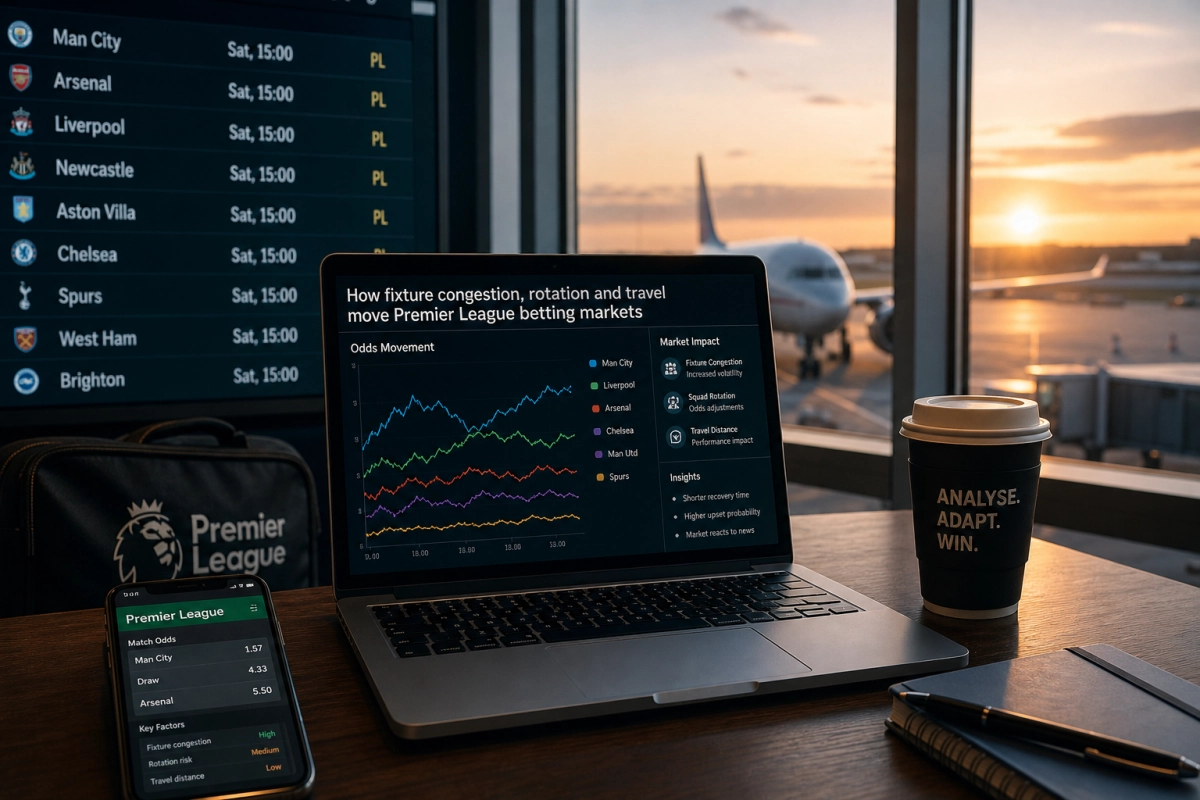
Fixture congestion isn’t abstract: a midweek Champions League or Europa League tie and a late cup replay can reduce starting-XI quality, lower intensity or increase defensive caution. Managers rotate to protect players, and travel — especially long European trips or late flights — adds tiredness and selection uncertainty. These elements shift probability, which the market reacts to via price moves and liquidity. Bettors who check a few items ahead of kick-off can find value or avoid games where odds underestimate rotation risk.
Practical pre-match checks every Premier League betting punter should run
Before placing a bet, run these quick checks. Each one takes a minute and links to clear market implications so bettors know which markets to target or avoid.
- Fixture timing: Count days since the last match. Two games in five days or three in nine increases rotation risk. Market impact: consider under 2.5 goals and reduced BTTS expectation.
- Midweek European or domestic cup tie: Confirm whether either side played midweek and its importance (e.g., knockout stage). Market impact: favourites more likely to be rotated — value in draw no bet (DNB) for the underdog or Asian +0.5/+1 handicaps.
- Travel burden: Note long-haul trips or late returns (overnight flights, cross-border travel). Market impact: fatigue can reduce pressing and attacking threat — favour low-goal markets.
- Rotation history: Check the manager’s recent team sheets. If the coach rotates heavily after European games, expect more fringe players. Market impact: avoid first-choice goalscorer bets; consider match goals markets instead.
- Key-player minutes: Scan last two match reports for minutes played by top creators and strikers. High minutes across matches raise injury/fatigue risk. Market impact: lower expected goals (xG) for teams missing creators, so under/BTTS adjustments apply.
- Confirmed team news: Wait for the official starting lineup (usually 60–90 minutes before kickoff). Market impact: odds may shift; be ready to hedge or exploit late movement.
Quick translations from checks to market actions
- High rotation + travel → consider Under 2.5 goals, BTTS No, or DNB on the rested away side.
- One side rested, other fatigued → favour handicap on rested team or DNB backing favourite; avoid high-risk correct-score bets.
- Both sides rotated heavily → smaller stakes on match-winner; target markets like total corners or cards rather than scorers.
These checks are intentionally simple so bettors can apply them across many fixtures. The next section will convert these checks into concrete market recommendations, worked example scenarios and simple data checks (minutes, team sheets, travel distance) that can be run before placing a Premier League betting stake.
Concrete market recommendations tied to pre-match checks
Below are actionable market plays mapped to the quick checks from earlier. For each, I give the rationale, which markets to prefer, and simple staking/odds guidance to help you size and spot value.
– High rotation by favourite after European/dominant cup tie (two games in five days, several starters rested)
– Rationale: weakened attack, unfamiliar combinations, lower intensity.
– Markets: Draw No Bet (DNB) on the underdog; Asian +0.5/ +1 for the underdog (favours safety); Under 2.5 goals and BTTS No.
– Staking: reduce stake by 25–40% vs normal because unpredictability increases variance.
– Odds signals: DNB for underdog >1.8 or favourite’s handicap shorter than -0.75 can represent fair value.
– One side clearly rested, the other fatigued (rested team had 5+ days)
– Rationale: fresh legs, sharper pressing and transition play from rested side.
– Markets: handicap on the rested side (Asian -0.5 or -0.75) or DNB on the favourite if they’re the refreshed team; consider Over 1.5 team goals for the rested side if price >1.6.
– Staking: normal stake or slightly higher when lineups confirm clear rest advantage.
– Both teams heavily rotated (early-round cup ties, boundary rotation)
– Rationale: weaker finishing quality, defensive disorganization but lower expected attacking threat.
– Markets: avoid first goalscorer and anytime scorer markets; prefer totals like Under 2.5, BTTS No, or alternative markets (corners/cards) where team identity matters less.
– Staking: reduce stake 30–50% and target multiple small stakes across low-correlation markets.
– Late travel/long-haul return (overnight flights or >800–1000 km in last 48 hours)
– Rationale: decreased high-intensity pressing, slow transitions.
– Markets: Under 2.5 goals, BTTS No; if road team is favourite, consider DNB or Asian +0.25 safety lines for the home underdog.
– Odds signals: if market keeps the favourite short despite travel, that can be exploitable for DNB value.
– Key-creator or striker likely rested/injured
– Rationale: drop in expected goals (xG) and chance quality.
– Markets: avoid player scorer markets; look to match goals markets and underlines (Under 2.5 or Under 3.5 if the opponent is weak defensively).
– Staking: reduce stake or use “small hedge” bets post-lineups.
Three worked examples and the exact data checks to run before you stake
Example 1 — Team A: European away Thursday; Team B: midtable rested Sunday
– Data checks (1–2 minutes): days since last match (Thursday→Sunday = 3 days); starting XI overlap in last two league matches for Team A (if <60% expect rotation); flight time/distance (if >800 km or overnight return mark fatigue).
– Market call: DNB on Team B or Asian -0.5 on Team B if odds >1.7. Consider Under 2.5 if Team A’s key attackers logged 160+ minutes over two matches.
– Quick threshold: starting XI overlap <60% = heavy rotation flag.
Example 2 — Both sides rotated heavily (Cup weekend, fringe XIs)
– Data checks: compare named starters vs typical XI; if each team makes 4+ changes, treat as “both rotated.”
– Market call: small stake on Under 2.5 and BTTS No. Avoid scorer markets. If both squads lack trusted strikers, push stakes smaller and split across corners/cards markets.
– Quick threshold: ≥4 changes = rotate-heavy; stack smaller stakes.
Example 3 — Home favourite fresh, away team long-haul return
– Data checks: minutes on key starters (sum of two matches >170 minutes = fatigue risk); travel overnight or >1000 km; confirmed lineups when published.
– Market call: favour Asian handicap on home (-0.5/-0.75) or DNB on favourite if price <1.6 still offers reasonable return. If favourite’s top scorer rested, drop confidence and reduce stake.
– Quick threshold: top attacker minutes >150 across last two matches = take reduced expectation for goals.
These checks and scenarios require only public match reports, team sheets and a quick distance check (Google/flight time). Doing them consistently redirects you to markets that survive rotation and travel volatility, and helps size stakes to the actual uncertainty in each Premier League fixture.
Putting the routine into live practice
Turn the checks in this guide into a repeatable pre-match routine, then protect the edge with sensible risk control and learning loops. The aim is not to predict every result but to tilt your staking toward markets that withstand rotation, travel and fixture congestion — and to shrink exposure when uncertainty rises.
-
Start small and record everything
Validate the approach with low stakes for a set sample (50–100 bets). Keep a simple log: date, fixture, rotation/travel flags, market, odds, stake, result and a short post-match note. Raw outcomes will tell you which thresholds and markets actually hold up.
-
Bankroll and staking discipline
Use defined unit sizes (e.g., 1% of bank = 1 unit). Reduce unit size when rotation or travel risk is high (the guide suggested 25–50% reductions). Cap exposure to correlated markets on the same match to avoid doubled losses.
-
Timing and market interaction
Wait for confirmed lineups before committing to high-confidence stakes. If you act before lineups, size stakes more conservatively. Use late price moves to spot value, but don’t chase volatile odds without backing from your checklist.
-
Measure, refine, adapt
Review performance regularly by scenario (e.g., favourite rotated after Europe, long-haul return, both sides rotated). Adjust your thresholds (minutes, overlap %, distance) based on empirical results rather than intuition.
-
Tools and automation
Automate simple checks where possible: alerts for team news, a spreadsheet to calculate minutes/overlap and travel distance, and a tracker for bets and ROI. Automation reduces human error and speeds decision-making when lines move fast.
-
Know when to step back
If lineups are unclear, markets are thin, or you’re emotionally biased toward a pick, the best action is often to skip the bet. Preserving bankroll and data integrity matters more than forcing activity.
Applied consistently, these practices convert a handful of quick pre-match checks into an operational edge: smaller, better-sized bets that reflect the real uncertainty created by fixture congestion, rotation and travel. Treat this as a process — record outcomes, learn, and let disciplined routines compound small edges into long-term gains.