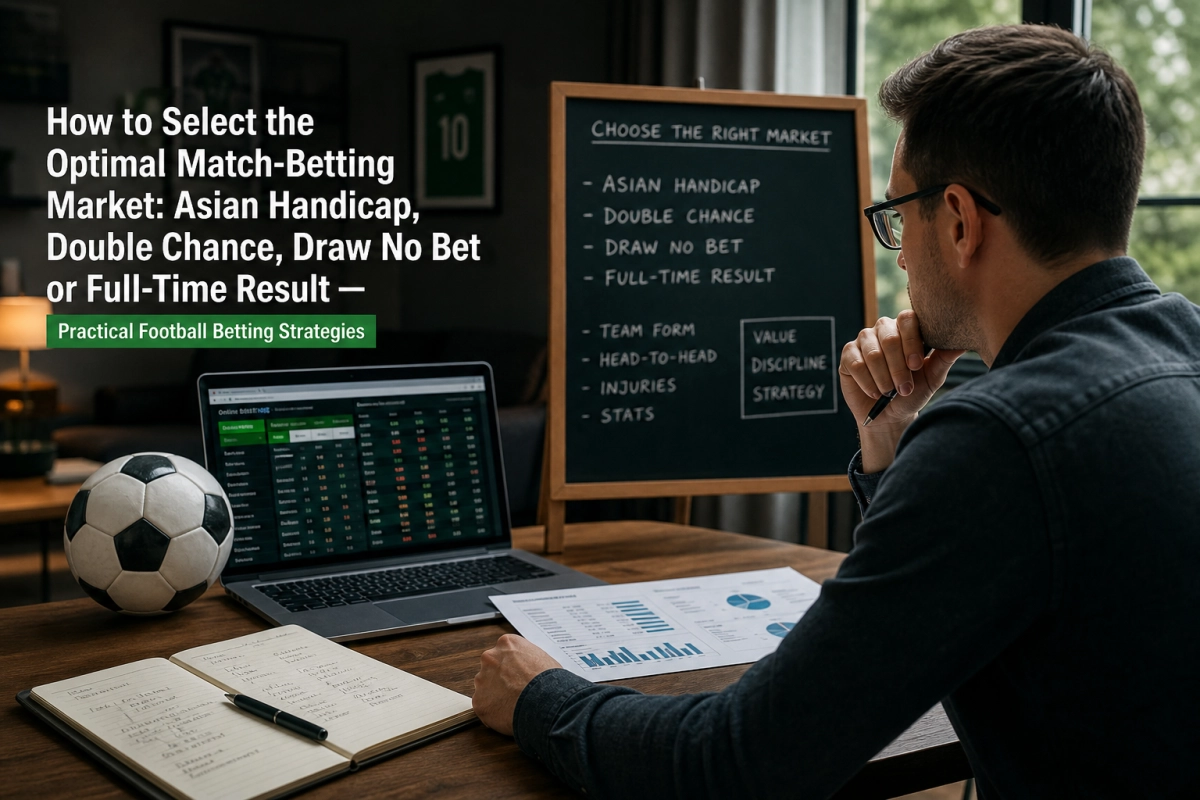
How to choose the best betting market for a match using form, tactics, xG and implied odds
Why selecting the right market is as important as picking a team
Picking a winner is only one part of successful football betting. The market you choose—Asian handicap, double chance, draw no bet, or full‑time result—determines how much edge, protection or payout you get. This guide lays out practical football betting strategies that use team form, tactical matchups, head‑to‑head records, home/away splits, injuries, expected goals (xG) and implied odds to select the most appropriate market for any pre‑match situation.
Readers will learn simple rules for matching match context to market type, how to read implied probability from odds, and which statistical signals push a selection toward a safer option (like double chance) or a higher‑value play (like Asian handicap).
Quick market definitions and practical uses
Full‑time result (1X2)
What it is: A straight bet on home win, draw, or away win. Best when one team is clearly superior and the odds reflect genuine value.
- Use when form, xG and injuries all favour a single outcome.
- Higher payout but no margin of error—losing by one goal still loses the stake.
Draw No Bet (DNB)
What it is: Your stake is returned if the match ends in a draw. You are effectively removing the draw outcome from the market.
- Useful when the favourite is better but the match could be tight—for example, a superior away side missing key attackers.
- Lower payout than 1X2, but reduces variance.
Double Chance
What it is: A two‑outcome bet (home or draw, away or draw, home or away). It gives the highest protection of the common pre‑match markets.
- Choose when uncertainty is high—mixed form, recent lineup rotation, or close head‑to‑head history.
- Odds are shorter, so reserve for situations where reducing downside matters more than maximizing return.
Asian Handicap
What it is: Handicaps level the perceived gap between teams. Options include whole‑goal and quarter‑goal lines that can produce half wins/refunds.
- Best for extracting value when one team is marginally better and the market overestimates the draw risk.
- Good when xG differentials suggest a likely winning margin but the 1X2 price doesn’t offer value.
Core data to weigh before choosing a market
- Recent form: Look beyond last‑5 wins/losses—check goal trends, clean sheets and opponent quality.
- Tactical matchups: A pressing, counter‑attacking side vs a possession team changes where goals will come from and whether a narrow result is likely.
- Head‑to‑head and style clashes: Some teams consistently draw or produce low‑scoring games against specific opponents—this steers toward DNB or double chance.
- Home/away splits: A team’s away defensive record or home scoring rate often dictates whether an Asian handicap is realistic.
- Injuries and suspensions: Missing creative or defensive starters alters probability more than raw form suggests—use DNB to limit downside if uncertainty is high.
- Expected goals (xG): xG trends identify whether results are sustainable. A team outperforming xG may regress; that affects whether to back a full‑time win or a safer market.
- Implied odds: Convert bookmaker odds to implied probability to spot market value. If your model’s probability exceeds implied odds, the market may be mispriced.
With these market definitions and the core data checklist, readers can begin matching scenarios to appropriate markets. The next section will demonstrate step‑by‑step how to apply these principles to a real match example and translate xG and implied odds into a concrete market selection.
Step‑by‑step market selection: a real‑match walkthrough
Take a hypothetical fixture to see the checklist in action: Home: Team A — a possession side with season xG/90 of 1.70; Away: Team B — a counter team with xG/90 of 1.05. Home advantage historically adds roughly +0.15–0.20 xG for Team A. Short injury note: Team B’s main striker is suspended; Team A is missing a rotational fullback only.
1. Calculate match xG expectations (simple adjustment)
– Team A expected xG = 1.70 + 0.18 (home uplift) = 1.88
– Team B expected xG = 1.05 (minus striker effect ≈ –0.20) = 0.85
– Net xG gap = 1.03
2. Translate xG gap into contextual win probability
– A 1.0+ xG gap typically signals a clear favourite — rough conversion here: home win ≈ 62–66%, draw ≈ 20–24%, away ≈ 12–16% (use your model or a Poisson routine for precision).
3. Compare to bookmaker implied odds
– Example market: Home 1.80 (implied 55.6%), Draw 3.60 (27.8%), Away 4.50 (22.2%).
– Your model gives home win ~64% — that’s ~8–9 percentage points of value over the book.
4. Select the market given value and context
– Value exists on the home side and the expected margin >1 xG. That supports an Asian handicap rather than straight 1X2: AH −0.5 (wins only if home wins) captures superior value while offering slightly better odds than a straight 1.80 back.
– Because the gap is large and the away attack is weakened, consider AH −1.0 if the AH price offers meaningful extra return and your model still shows >8–10% edge. AH −1 cushions against a one‑goal squeaker only if your probability of a multi‑goal home win exceeds the implied probability priced by the book.
5. When to downgrade to safer markets
– If head‑to‑head history shows a high draw frequency vs this tactical matchup (e.g., both sides produce low shots in recent matches), shift to DNB or double chance even with a model edge — protection against an elevated draw risk.
– If injury news arrives late that reduces your confidence, prefer DNB (refund on draw) or double chance (home/draw) to trim variance.
This structured flow — compute adjusted xG, derive probabilities, compare to implied odds, then select a market based on margin and context — converts raw data into a concrete market choice.
Translating xG differentials and implied probabilities into market rules of thumb
Turn the walkthrough into simple rules you can apply quickly pre‑match:
– xG gap ≈ 0.0–0.3: Market is finely balanced. Default to 1X2 only if odds show clear value; otherwise use DNB or double chance because draw risk and variance are high.
– xG gap ≈ 0.3–0.7: Small but meaningful advantage. Consider Asian handicap −0.25 or −0.5 if implied odds understate your model advantage by 4–7 percentage points. Use −0.25 to split risk when you want partial refund if the match draws.
– xG gap ≥ 0.8–1.0: Strong advantage. Look at AH −0.5 or −1.0 depending on how much of that gap is driven by opponent injuries or tactical mismatch. If your model’s home win probability exceeds bookmaker implied by ≥8–10 points, AH −1 is often justified.
– High draw/trap signals (historical H2H draws, tactical low‑shot games): favour DNB or double chance even when xG favours one side — those signals reliably inflate draw probability.
– Late lineup or weather uncertainty: shrink exposure. Move from AH or 1X2 to DNB/double chance to preserve bankroll during volatility.
Finally, use quarter‑goal Asian lines (-0.25, +0.25) to calibrate confidence: they’re an elegant middle ground — part protection, part upside — when your model shows modest but real edge and match signals are mixed. Keep these rules as compact checklists and you’ll systematically match market selection to the quantitative and contextual signals the match presents.
Applying the approach consistently
Data, context and discipline together create an edge — but only if you treat market selection as a repeatable process. The competitive advantage comes from testing hypotheses, tracking outcomes, and making small, evidence‑based adjustments rather than reacting to each match emotionally.
- Start small: use low stakes while you validate your method and learn how markets move in practice.
- Log everything: date, fixture, market chosen, odds, model probability, stake and result. Review monthly to spot biases and shrinkage effects.
- Backtest and iterate: test rules on historical fixtures and live samples. If the edge disappears after accounting for vig and limits, refine your inputs or market focus.
- Use a clear staking plan: fixed unit sizing or a disciplined Kelly variant prevents bankroll erosion during variance spikes.
- Guard against noise: only change rules after statistically meaningful performance shifts, not after a short losing run.
- Keep situational checks brief but non‑negotiable: last‑minute lineup changes, weather or scheduling issues can flip market logic and should trigger automatic reassessment.
Treat market selection as an engineering problem: build simple, testable rules, measure results, and optimize incrementally. Over time, this disciplined loop — rather than a single “perfect” pick — is the most reliable path to consistent value extraction from betting markets.