Premier League Betting: Use Home and Away Form to Assess Matches
Why venue-specific form matters in Premier League betting
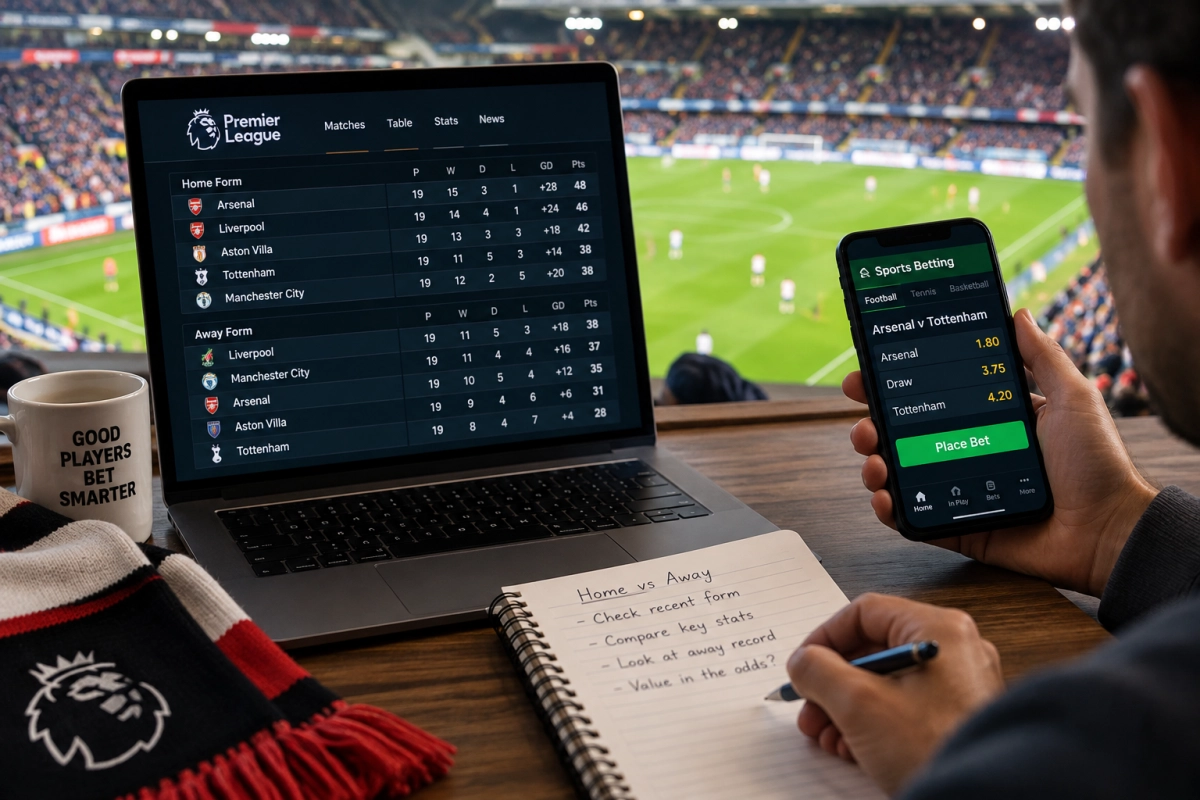
When you assess a Premier League fixture, overall league position or a team’s last five results only tells part of the story. A side may be far more effective at home than away, while its opponent might defend well on the road but struggle to create chances. Comparing performance by venue gives you a more relevant starting point for match analysis and market selection.
Begin with each team’s home or away record, depending on where the match is being played. Look at wins, draws and losses, but also check goals scored and conceded. These figures can help you ask practical questions: does the home side regularly create chances, and can the visitors keep opponents from scoring? They do not determine what will happen in one match, but they help you build a more balanced view.
Context matters. A short run of results can be shaped by strong or weak opposition, red cards, injuries, or a demanding schedule. Treat venue records as one piece of evidence, not as a prediction by themselves. For example, a team with several recent home wins may still face a difficult test against an opponent whose away defence has been reliable.
Compare home and away data beyond wins and losses
Goals for and against can reveal patterns that a win percentage misses. A home team that scores consistently but also concedes often may be more relevant to a goals market than a straightforward home-win bet. Meanwhile, a side that scores few away goals could make a high total less appealing, even if its matches have been competitive.
Useful figures to compare include:
- Goals scored and conceded: Check each team’s average per home or away match, as appropriate.
- Clean sheets and matches without scoring: These offer clues about defensive reliability and attacking consistency.
- Expected goals (xG): This estimates the quality and quantity of chances created and allowed. It can add context when results do not reflect a team’s performances.
- Recent venue-specific form: Review a reasonable run of games, while remembering that small samples can be misleading.
Season-wide figures can also help set expectations, but they are not a forecast for a particular fixture. For instance, a snapshot after 100 Premier League matches in 2026/27 recorded 42% home wins, 27% draws and 31% away wins. That broad split shows why home advantage should be considered, not assumed to settle the result. Team-level performance and current circumstances still matter.
Connect the evidence to a suitable betting market
Once you have compared the venue data, consider which market best matches your reading of the game. The match result market—often called 1X2—asks you to choose a home win, draw or away win. If the home side looks stronger but a draw remains a concern, double chance covers two of those outcomes. Draw no bet returns your stake if the match finishes level, subject to the bookmaker’s rules.
For goals, over/under betting asks whether the total will be above or below a set line, such as 2.5. Both teams to score (BTTS) is a separate choice on whether each side will score at least once. Strong attacking home numbers combined with frequent away concessions may support investigating these markets, but check both teams’ figures rather than relying on one trend.
Next, we’ll look at how to weigh those statistics against team news and tactical matchups before narrowing down the market.
Adjust venue statistics for team news and match conditions
Home and away numbers describe what a team has done, but the likely line-up can change how useful those numbers are. Check confirmed absences and doubts, especially in positions that affect chance creation or defensive organisation. A missing centre-back may weaken an away side’s ability to protect its box; the absence of a leading forward could make its away scoring record less relevant to the next fixture.
Consider whether a replacement is likely to fill the same role. Losing a winger who carries the ball forward, for example, may affect a team’s ability to counter even if another attacker takes their place. Also look at rest and schedule: a side playing after a short turnaround may have less energy to press or recover, while a team with a full week to prepare may be better placed to execute its usual approach. Treat these as adjustments to the evidence, not certainties.
Use tactical matchups to interpret venue patterns
Statistics become more informative when you consider how the teams are likely to approach the match. A home side that presses aggressively may trouble visitors who have struggled to play out from the back. But if those visitors are effective on the counter, committing players forward could also leave the home team exposed. The matchup may therefore point towards chances at both ends rather than a simple home-win outlook.
Look for signs of how each team creates and concedes opportunities, such as crosses, set pieces, transitions or possession in dangerous areas. If the home team’s strong scoring record comes mainly from set pieces, check whether the visitors have been vulnerable in those situations. If an away side tends to sit deep, ask whether the home team has shown it can break down compact defences. These details can help explain whether a trend is likely to fit this particular fixture.
Choose a market that reflects the strength of your evidence
Before selecting a bet, write down what your data suggests and what could undermine that reading. If the clearest evidence concerns scoring at both ends, a goals market may fit better than choosing a winner. If the venue records suggest one team has an advantage but the matchup or team news leaves the result uncertain, consider whether a market with more cover is more appropriate—or whether the evidence is too mixed to bet on.
Compare the available odds with your assessment rather than treating a likely outcome as automatically good value. A strong home record may make a home win plausible, but the price still matters. Avoid combining several trends as if each independently guarantees the same result; many statistics overlap, and a small sample can exaggerate a pattern. Set a budget before betting, keep stakes manageable, and be prepared to pass when the data does not support a clear view.
Make a considered final decision
No set of statistics can remove the uncertainty from a Premier League match. Let your assessment guide you, but do not feel obliged to place a bet when the evidence or price does not convince you. Bet only what you can afford to lose, and keep the decision in perspective.