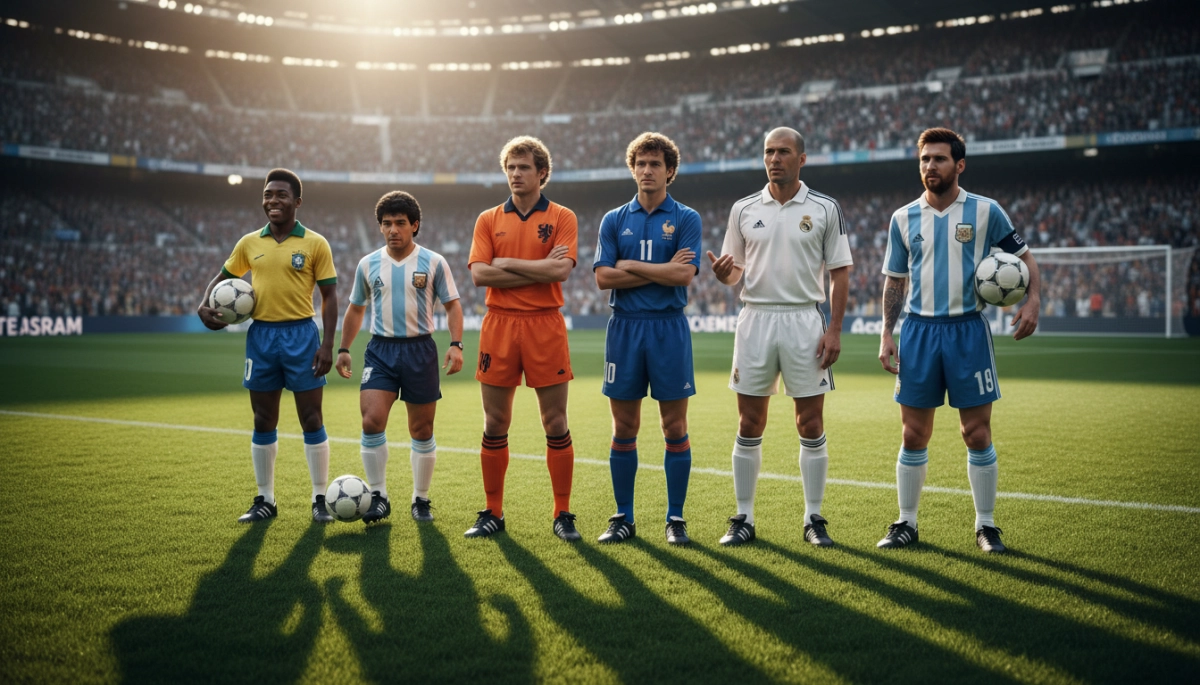
Why Pele and the earliest icons still shape how you see soccer
When you watch a contemporary match, many of the tactics, skills, and superstar narratives trace back to players from the mid-20th century. These pioneers did more than score goals: they helped globalize the sport, created enduring playing styles, and became cultural ambassadors for soccer. Understanding their contributions gives you a clearer view of why later figures—like Maradona, Cruyff, and ultimately Messi—are celebrated not only for statistics but for the way they altered football’s DNA.
Pele: the player who turned soccer into a global spectacle
You’ll often hear Pele’s name when people discuss the greatest of all time, and for good reason. Pelé (Edson Arantes do Nascimento) combined prolific scoring, tactical intelligence, and an uncanny ability to perform on the biggest stages. From his breakout as a teenage sensation in Sweden 1958 to three World Cup titles (1958, 1962, 1970), Pele helped export Brazilian flair and the concept of the footballing superstar.
- Technical signature: exceptional dribbling, two-footed finishing, and spatial awareness that let him exploit defenses.
- Records and milestones: hundreds of official goals for club and country, plus an aura that drew global attention to domestic leagues and international friendlies.
- Cultural impact: you can see his influence in how national teams adopted a more expressive, attack-focused identity and in how sponsors and media began framing players as global celebrities.
As you study his era, you’ll notice the interplay between skill and spectacle: Pele’s goals were often improvisational but also rooted in an intelligent reading of the game—an approach that modern coaches and analysts still reference.
Early contemporaries and predecessors who paved the way
Pele didn’t emerge in a vacuum. Before and alongside him, other figures laid tactical and cultural foundations that you should recognize when tracing soccer’s evolution.
- Ferenc Puskás: Hungary’s post-war maestro who showcased lethal finishing and a team-oriented, possession-based approach that pressured defenses in new ways.
- Alfredo Di Stéfano: the multi-faceted Real Madrid star whose positional fluidity and ability to both create and finish attacks helped define the modern forward.
- Garrincha: Brazil’s wing wizard whose dribbling and individuality complemented Pele, showing you how different styles within the same team can create unmatched balance.
By studying these players, you begin to see a pattern: incremental innovations in technique and tactics accumulated into the modern game’s variety. When you next watch a forward drop deep to link play or a winger attempt to dismantle a defense one-on-one, you’ll be seeing echoes of these pioneers.
Next, you’ll move forward in time to examine the transformative forces of the 1970s through the 1990s—players like Cruyff and Maradona—and how their breakthroughs set the stage for Lionel Messi’s era.
From Total Football to cult hero status: Johan Cruyff and Diego Maradona
The 1970s and 1980s introduced two contrasting types of game-changing talent: the cerebral architect and the incandescent maverick. Johan Cruyff and Diego Maradona rewrote what you expect from a single player—one by reframing positional play, the other by making individual brilliance a tactical weapon.
- Johan Cruyff — the philosopher-player: Cruyff personified “Total Football” with the Dutch national team and Ajax, where positional interchangeability and relentless pressing became organized art. His technical excellence was paired with an extraordinary tactical IQ: dropping deep to orchestrate, bursting forward as a false nine, and demanding team structures that prioritized space over rigid roles. Cruyff’s influence extended into coaching and club philosophy—his ideas were foundational to Ajax and later Barcelona’s youth identity, which prioritized on-ball intelligence and positional flexibility.
- Diego Maradona — the disruptive genius: Where Cruyff reshaped systems, Maradona bent games with moments of pure, unrepeatable skill. His dribbling, balance, and ability to carry entire attacks defined the 1986 World Cup and elevated Napoli to unprecedented domestic glory. Maradona showed you how one extraordinary player could compensate for tactical limitations, turning nimble improvisation into a repeatable match-winning tool. Off the field, his persona—flawed, politically charged, and mythic—made him a symbol for cities and nations that saw him as more than an athlete.
Both players reframed expectations: Cruyff for how teams could be organized around intelligence and movement, Maradona for how an individual could alter a game’s momentum through sheer technical mastery. Coaches and academies have since sought to synthesize those lessons—teaching young players to think like Cruyff and execute like Maradona.
Speed, spectacle, and the modern superstar: Ronaldo, Zidane, and Ronaldinho
The 1990s and early 2000s blurred the line between athleticism and artistry. Advances in training, broadcasting, and club finance created global stages that amplified extraordinary players—Ronaldo Nazário, Zinedine Zidane, and Ronaldinho each exemplified a different facet of the modern superstar.
- Ronaldo (Brazil): A prototype for the modern striker, Ronaldo combined explosive acceleration, low center of gravity, and clinical finishing. He forced tactical adaptations—defenses could no longer rely solely on organization; they had to account for genuine match-winning pace and unpredictability inside the box. Despite injury setbacks, his 1998 and 2002 World Cup campaigns and successive Ballon d’Ors left a clear legacy for how strikers are scouted and developed.
- Zinedine Zidane: Elegance and control in midfield became a premium again with Zidane. His spatial command, vision, and ability to decide finals (notably the 1998 World Cup and the 2002 Champions League volley) showcased a model of midfield supremacy built on composure rather than raw athleticism. Zidane reminded coaches that tempo control and game management can be as decisive as relentless pressing.
- Ronaldinho: Joyful improvisation returned as a tactical asset. Ronaldinho’s creative freedom at Barcelona in the mid-2000s married street-level trickery with elite professionalism, helping revive Barca’s fortunes and inspiring a generation to value skill, unpredictability, and playmaking flair. His mentoring role—most famously his early encouragement of a young Lionel Messi—underlines how stylistic lineages are passed between stars.
Together, these players bridged eras: introducing the athleticism, technical nuance, and global celebrity that defined 21st-century soccer. Their mix of speed, control, and charisma set the explicit stage for Lionel Messi’s emergence—combining positional intelligence (Cruyff), dribbling audacity (Maradona), explosive efficiency (Ronaldo), and creative joy (Ronaldinho) into the modern blueprint of greatness.
Messi and the modern benchmark
Lionel Messi represents a contemporary culmination of the traits developed across generations: extraordinary close control, low center of gravity, passing vision, and an uncanny consistency at the highest level. His career—marked by club longevity, Ballon d’Or recognition, and a World Cup triumph—has set new statistical and cultural standards while also inspiring coaching methods that emphasize creativity, small-sided skill work, and positional intelligence.
- Technical signature: tight-space dribbling, quick combination play, and an ability to finish with both precision and subtlety.
- Legacy in development: youth academies and grassroots coaches increasingly prioritize game intelligence and ball mastery, hallmarks of Messi’s style.
What the legends teach us going forward
These iconic players do more than occupy highlight reels: they shape training, club identities, and how you understand what a single player can do for a team. As soccer continues to evolve—through technology, analytics, and shifting tactical trends—the stories of Pele, Cruyff, Maradona, Ronaldo, Zidane, Ronaldinho, and Messi will remain reference points for coaches, players, and fans. If you want to explore official player histories and records further, start with resources like FIFA player profiles.
Frequently Asked Questions
Who is considered the greatest soccer player of all time?
There is no single answer—opinions vary by era, criteria, and personal preference. Pele, Diego Maradona, and Lionel Messi are often cited because of their influence, trophies, and match-defining moments; others favor Cruyff, Alfredo Di Stéfano, or modern stars depending on whether they value tactical innovation, individual brilliance, or longevity.
How did players like Cruyff and Maradona change how teams play?
Cruyff popularized positional interchange and collective pressing—ideas that became core to “Total Football” and club philosophies—while Maradona demonstrated how extraordinary individual skill could unbalance opponents and become a central tactical resource. Both shifted coaching priorities toward intelligence, movement, and the tactical use of individual strengths.
Is Lionel Messi a direct successor to Pele?
Messi is part of a lineage rather than a direct successor. He inherits elements from many predecessors—Pele’s winning mentality, Cruyff’s positional intelligence, Maradona’s dribbling artistry—but his era, playing conditions, and statistical achievements are distinct. Greatness is contextual, and Messi’s place in history reflects a blend of old influences and modern evolution.