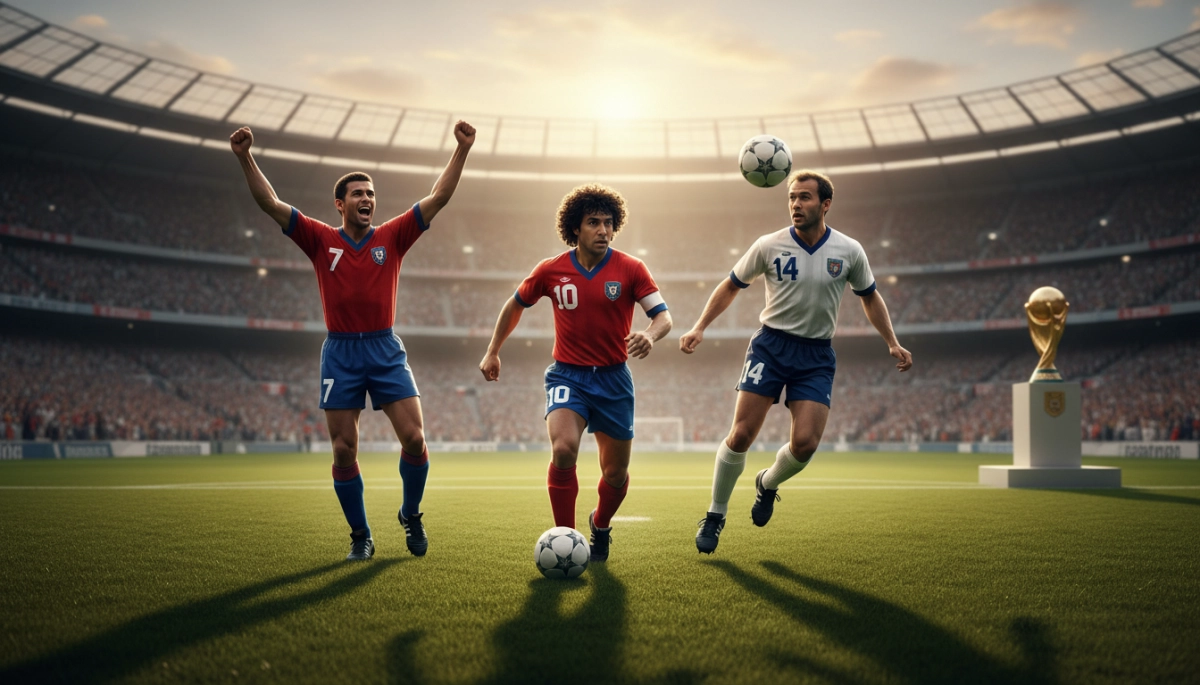
Why football legends still matter and how you should think about them
You live in a sport shaped by personalities, moments, and records. The greatest footballers of all time aren’t just a list of names; they are touchstones that tell you how tactics evolved, how skill is perfected, and how global culture adopted the game. When you study legends, you’re tracing tactical revolutions, social impact, and measurable excellence on the pitch.
This section helps you frame greatness before you dive into player-by-player analysis. Rather than treating accolades as the only yardstick, you’ll learn to weigh context, versatility, and influence. That approach lets you compare a striker from the 1960s with a playmaker from the 2010s without falling into simple stat comparisons.
How you can measure greatness across different eras
Key categories to consider
- Statistical output: goals, assists, clean sheets, and per-game impact show measurable value, but numbers must be normalized by season length and competition difficulty.
- Trophies and individual awards: World Cups, continental titles, Ballon d’Ors and equivalent honors reflect both personal excellence and team success.
- Technical and tactical influence: some players introduced moves, roles, or tactical concepts that changed how teams play—your evaluation should include innovation.
- Longevity and consistency: peak seasons matter, but so does the ability to sustain top-level performance across a decade or more.
- Contextual impact: leadership in big matches, ability to carry weaker teams, and cultural resonance are qualitative but essential factors.
Why raw stats can mislead you
When you look at goal totals or assist counts, you must ask: what league was the player in, how many matches were played, and what tactical role did they have? For example, a prolific forward in a high-scoring era will naturally post bigger numbers than a modern defensive midfielder whose value is measured in interceptions and positional control. You should therefore favor normalized metrics (goals per 90, goal contribution share) and match-impact indicators (decisive goals, man-of-the-match performances).
Foundations laid by early-era icons you should know
Before contemporary superstars, certain figures built the templates later players followed. You’ll recognize recurring themes when you study these pioneers: extraordinary technical skill combined with tactical intelligence, and the capacity to perform on the biggest stages.
- Players who redefined attacking roles and scoring instincts, setting benchmarks for future forwards.
- Midfield architects who demonstrated how vision and control could dominate matches beyond raw athleticism.
- Defenders and goalkeepers who shifted expectations for leadership, distribution, and sweeper systems.
Understanding these early contributions gives you a lens to evaluate later careers fairly—you’ll see which traits are durable and which are products of their time. In the next part, you’ll start examining individual legends in detail, beginning with the careers that had the biggest statistical and cultural impact.
Pelé and Maradona: myth, metrics, and match-defining moments
Two names dominate early G.O.A.T. arguments because they combine staggering outputs with unforgettable drama. Pelé’s raw statistical footprint—official club and international tallies that still sit among the all-time leaders—pairs with three World Cup wins, a rarity that anchors his claim in both volume and silverware. But numbers alone don’t explain his legacy: Pelé expanded the archetype of the complete forward, mixing athleticism, finishing variety, and spatial intelligence in an era with fewer matches and less protective officiating. When you assess him, normalize for season length and defensive rigor of the time; his goals-per-90 and team-dependence metrics still compare exceptionally to later generations.
Maradona is the counterpoint: fewer trophies overall but arguably a higher cultural intensity. His 1986 World Cup remains a case study in individual influence—decisive dribbles, game management, and the polarizing “Hand of God” moment illustrate how narrative shapes legacy. At club level his transformation of Napoli from an also-ran to a champion captures contextual impact: carrying a team historically outside the top echelon is a form of greatness that raw totals don’t capture. When comparing Pelé and Maradona, weigh transferable metrics (goals, assists per 90) alongside qualitative factors—match-winning episodes, ability to elevate surrounding teammates, and symbolic resonance in national identity.
Cruyff and Beckenbauer: reimagining roles and tactical blueprints
Some legends are as important for what they taught the game as for the trophies they won. Johan Cruyff redefined the attacking midfielder/false nine hybrid and, more importantly, codified Total Football’s principles—positional interchange, vertical pressing, and building from midfield. His influence is measurable in coaching trees and tactical templates at Ajax and Barcelona; when you track the diffusion of his ideas, the effect extends decades beyond his playing peak. Evaluate such players by their tactical lineage: how many successful managers or clubs explicitly cite their methods, and how often do core ideas persist in elite-level formations?
Franz Beckenbauer offers the complementary defensive revolution. The modern sweeper (libero) owes much to his reading of space, progressive carrying out from the back, and leadership in high-pressure finals. He transformed defending into a proactive, creative phase of possession, which modern centre-backs and ball-playing defenders continue to mirror. For architects-of-role players, include metrics like passes completed under pressure, progressive carries from defensive third, and success rate in turning defense into attack—numbers that help quantify inventiveness beyond goals and trophies.
Messi and Cristiano: modern standards, rivalry, and statistical clarity
The most data-rich era gives Lionel Messi and Cristiano Ronaldo an unusually clear numerical case: Ballon d’Or counts, continental and club records, and detailed per-90 analytics that survive direct comparison. Messi’s game is defined by playmaking efficiency, chance creation, and an astonishing goals-per-shot ratio; Cristiano’s by physical adaptation, aerial dominance, and an unparalleled knack for decisive moments in the Champions League. Their rivalry compressed a generation of football discourse into measurable categories—consistency at peak, adaptability across systems, and record-breaking frequency.
When you place them in the pantheon, use normalized peak windows (for example, three-to-five-season stretches), clutch-goal indices, and cross-league calibration. That combination of granular stats and the broader narratives of rivalry, longevity, and evolution is why this duo will anchor modern discussions of greatness for decades to come.
Final reflections on football’s lasting stories
Greatness in football will always be part evidence, part emotion. Use the frameworks and context above as tools rather than verdicts: they help you ask the right questions about a player’s impact, not declare an absolute ranking. Keep watching matches, consult primary records, and follow how tactical ideas travel across generations—those practices will sharpen your view. For historical reference and tournament context, authoritative resources such as the FIFA World Cup history can be a useful starting point.
Frequently Asked Questions
How should I compare players from different eras?
Compare by normalizing measurable outputs (goals/assists per 90, trophies per available competitions) and by assessing role and context—what tactical system they played in, the quality of opponents, and season length. Balance stats with qualitative factors like influence on teammates and tactical innovation.
Why are Pelé and Maradona often at the center of G.O.A.T. debates?
They represent contrasting but compelling cases: Pelé for extraordinary volume and multiple World Cups; Maradona for transformative single-tournament brilliance and cultural impact. Debates persist because legacy blends measurable success with narrative power—both matter in how history remembers a player.
Which metrics matter most when arguing a player’s place among the greatest?
Prioritize normalized statistical measures (per-90 metrics, peak-window performance), major trophies and individual honors, clutch or decisive-match impact, longevity, and tactical influence. Don’t ignore qualitative evidence—match footage, contemporaneous reports, and the player’s role in evolving how teams play.