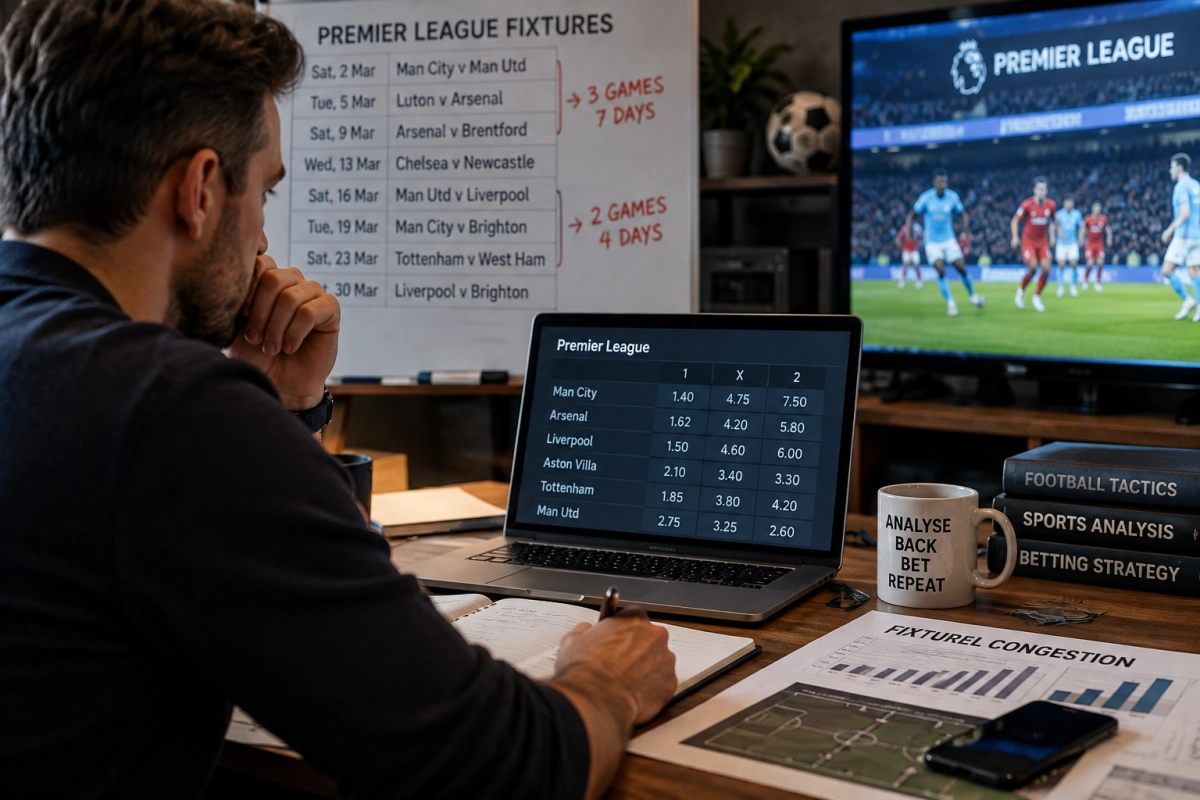
Why Fixture Congestion Matters in Premier League Betting
Fixture congestion can change the way a Premier League match should be assessed. A team may have stronger recent form, better underlying statistics or home advantage, yet still face a difficult betting situation after several demanding matches in a short period. Analysing the schedule helps bettors judge whether fatigue and likely rotation are already reflected in the football odds.
Congestion generally means that a club plays multiple matches with limited recovery time. A particularly important warning sign is a turnaround of 48 to 72 hours, or a run of three matches across seven to ten days. The schedule should be reviewed alongside competition importance, match intensity and the number of minutes played by key individuals.
Team-level match counts can be misleading. One club may have played four matches in two weeks, but its most important players may have started all four. Another may have rotated heavily and protected its main attackers. For that reason, effective Premier League betting analysis separates the overall schedule from individual player exposure.
- Record the date and location of each recent fixture.
- Note whether the previous match required extra time.
- Compare the likely starting players’ minutes across the schedule.
- Consider whether the next match has greater tactical or competitive importance.
Measuring Recovery Time and Physical Demands
Recovery time is more than the number of days between kick-offs. Travel after the previous match, late finishes, training disruption and the intensity of the contest can all influence preparation. A team returning from a demanding European away fixture may have less practical recovery than the calendar suggests, particularly when the next match is also away from home.
Short turnarounds can affect pressing, defensive concentration and the ability to maintain a high tempo. These effects may become more visible after half-time, making second-half markets relevant. However, congestion should be treated as a probability adjustment rather than an automatic reason to oppose a strong side. Elite clubs often have deeper squads, better recovery resources and enough quality to manage difficult periods.
Reading the Schedule in Context
A useful comparison involves the two teams rather than one schedule in isolation. If both sides have limited rest, the disadvantage may be smaller than expected. If one club has enjoyed a full week of preparation while the other has travelled internationally and played extra time, the difference may be more significant.
Market selection should follow the analysis. Fatigue may reduce confidence in a full-time result, while a cautious approach could focus on double chance or draw no bet markets. In goals betting, tired defending can support an over-goals or both teams to score argument, but rotation among attackers may point in the opposite direction. The likely lineups remain essential before any conclusion is reached.
Assessing Squad Rotation and Likely Lineup Changes
Rotation should be assessed by position, not simply by counting how many changes a manager makes. Changes to the goalkeeper, centre-backs, full-backs and holding midfielders can affect defensive organisation and buildup quality. In attack, resting a leading striker or creative midfielder may reduce chance creation even when the replacement is technically capable.
Team news should therefore be divided into confirmed absences, strong selection indications and mere speculation. A projected lineup is not guaranteed, and betting decisions should account for uncertainty until official team sheets are released. The next stage is to examine how travel and rotation combine to influence specific markets.
Evaluating Travel Demands and Away-Day Disruption
Travel can increase the effect of fixture congestion, especially when a club has recently played away from home or must cross borders before the next league match. The distance itself is only one factor. Flight schedules, late arrivals, unfamiliar surroundings and reduced training time can all affect how a team prepares.
European away fixtures deserve particular attention when they are followed by a Premier League match within two or three days. A club may return late, hold only a light recovery session and then travel again domestically. This can reduce sharpness without necessarily producing an obvious decline in the final result. The impact may instead appear through slower starts, fewer high-intensity sprints or an inability to sustain pressure.
Travel should also be considered alongside the location of the next fixture. A team returning from an away match and then travelling again has a different physical and logistical burden from one that comes straight back to its home training ground. Conversely, a home side may benefit from familiar facilities and no match-day travel, although the demands of hosting a midweek fixture can still limit preparation.
- Measure the distance and timing of the previous journey.
- Check whether the club crossed national borders or time zones.
- Identify whether the next fixture is also away from home.
- Compare travel demands for both teams rather than judging one in isolation.
Linking Rotation to Tactical and Market Effects
The important question is not only who may be rested, but what the change does to the team’s playing style. Replacing an energetic full-back can reduce overlapping attacks, while losing a ball-winning midfielder may leave the defence more exposed in transition. A rotated centre-back pairing can also affect the offside line and communication when facing a quick attack.
Likely lineup changes should therefore be mapped against the opponent’s strengths. If a team is expected to rotate its wide defenders against an opponent that relies on wingers, the away side may have greater scope to create chances. If both managers are likely to protect their attacking players, the match may become slower and less open, particularly when the schedule encourages risk management.
Substitution patterns provide useful supporting evidence. Some managers replace key players early when leading, while others retain their strongest lineup and make changes only when the result is secure. Historical rotation tendencies can help estimate whether a predicted change is meaningful, but previous decisions should not be treated as a fixed rule. The competition, league position and upcoming opponents all matter.
Turning Lineup Uncertainty into a Betting Assessment
When team news is uncertain, bettors should avoid treating a probable lineup as confirmed information. Instead, create more than one match scenario. One scenario might include the first-choice striker and two regular midfielders; another might assume a weakened attack and a more conservative formation. The potential difference between these scenarios shows how sensitive the market is to selection news.
Markets with longer settlement periods can be particularly vulnerable to late information. A price on the match winner may move sharply after a key absence is confirmed, while goals, corners and player-performance markets can react in different ways. A missing striker may reduce expected goals but increase the likelihood that wide players take more shots or deliver more crosses.
Comparing the bookmaker price with the revised probability is essential. Rotation and travel are relevant only when they create a gap between the true chance of an outcome and the available odds. If the market has already adjusted for the expected changes, the correct decision may be to wait, seek a different market or avoid the fixture altogether.
Making Better Decisions in Congested Periods
The most reliable approach is to treat fixture congestion as a source of uncertainty rather than a prediction in itself. A tired squad can still win, while a heavily rotated team may perform efficiently if its replacements suit the tactical plan. The value comes from identifying when schedule-related information has been underestimated by the market.
Reassess the fixture as team news develops, compare the available price with your revised probability and be prepared to pass when the evidence is too uncertain. In congested periods, disciplined selection is often more valuable than forcing a bet on every match.