How to Evaluate La Liga Over/Under Goals Bets
Start with the goal line, not a prediction
La Liga over/under goals bets are wagers on whether a match will finish with more or fewer goals than a bookmaker’s total. For example, over 2.5 wins if the match has at least three goals; under 2.5 wins if it has two or fewer. The half-goal line avoids a tie, though other totals can have different settlement rules.
Before assessing a fixture, treat the goal line as a question: how likely is this match to produce that total? Your answer should combine evidence from both teams rather than rely on a recent scoreline or a general impression that Spanish football is high- or low-scoring. League-wide averages can provide context, but they are only a starting point. They do not account for the teams, venue or matchup in front of you.
Keep the outcome separate from the process. A match can produce an unexpected late goal without making a sound pre-match assessment unreasonable. Your aim is to estimate a probability from available information, then compare it with the price—not to claim certainty about the final score.
Combine scoring and conceding patterns with expected goals
Begin with each side’s goals scored and conceded per match. A team that regularly scores and faces opponents who concede often may support an over case; a team that creates little and defends reliably may point toward an under. Check how many matches the figures cover and whether the schedule was unusually difficult or favourable. A handful of results can be noisy, so avoid treating a short streak as a dependable trend.
Expected goals (xG) can add useful context. It estimates the quality of chances created, while expected goals against (xGA) estimates the quality of chances allowed. Comparing these with actual goals can show whether a team’s recent totals reflect steady chance creation or finishing that may be difficult to sustain.
- High goals and high xG: scoring may be supported by regular, good-quality chances.
- Few goals but stronger xG: results may understate the chances created, though conversion is never guaranteed.
- Low xGA: opponents may be getting fewer or weaker chances, supporting an under argument.
- High xGA: defensive vulnerability may increase the potential for goals.
Use these measures together, not as automatic betting signals. Data providers may calculate xG differently, and a team’s figures can shift with personnel, tactics and opponent quality. Look at shot locations and clear chances where available, rather than assuming every shot carries the same threat.
Build a fixture-level view before checking prices
For a practical first pass, note each team’s scoring and conceding rates, compare those figures with its xG and xGA, and consider whether the sample is large enough to be informative. Then ask what could change the usual pattern: a missing striker, a defensive suspension, a congested schedule or a likely change in approach. Confirm team news close to kickoff; do not treat speculation as fact.
Record a tentative view—over, under or no clear preference—before looking at odds. This helps reduce the temptation to build a case around an appealing price. Next, examine whether home and away splits, tactical styles and the bookmaker’s implied probability strengthen or weaken that initial assessment.
Separate home and away goal patterns
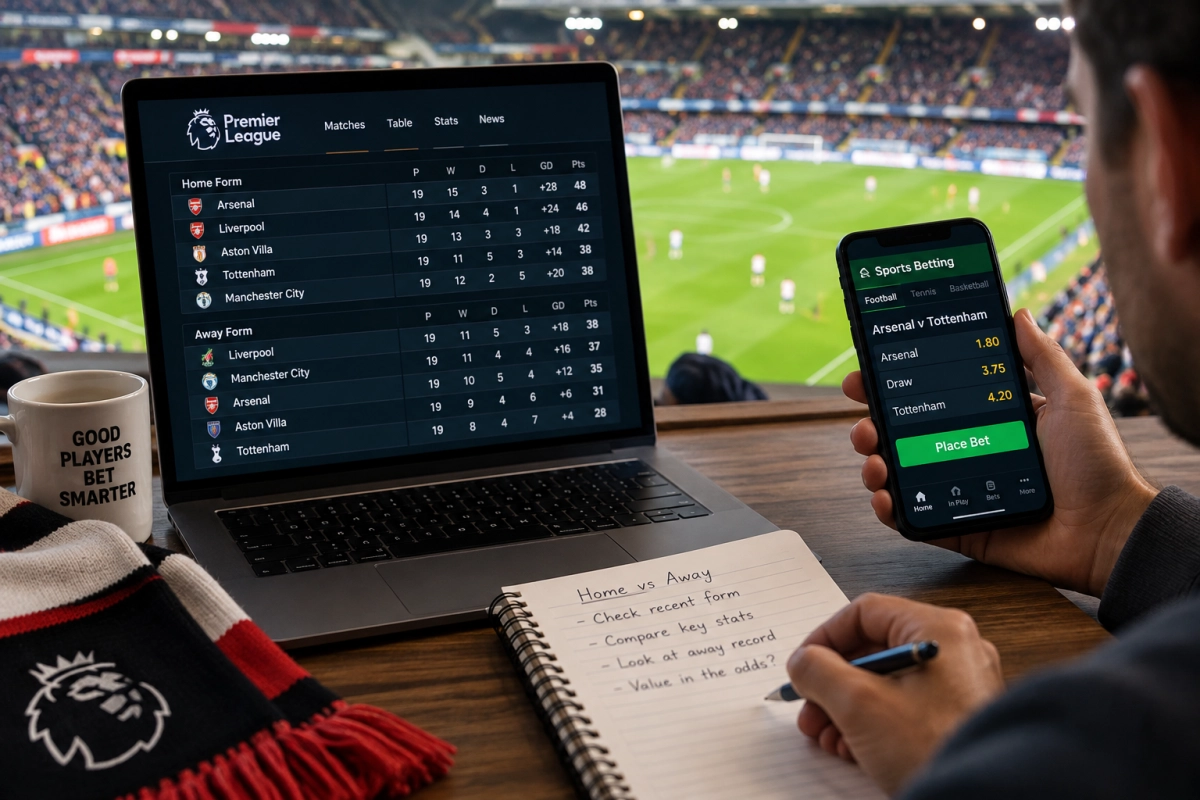
Overall team averages can hide a meaningful venue effect. A side may create more chances at home, where it presses higher and has greater support, but adopt a cautious approach away. Compare home scoring and conceding figures with the opponent’s away record, and check the same split in xG and xGA where sample sizes allow.
Do not assume a split will persist just because it appears in the data. A few unusual matches can skew a team’s home or away average, and opponents faced at each venue may differ in strength. Compare the figures with the broader season record and look for a plausible explanation, such as a consistent change in formation or pressing intensity. If the sample is small or the difference is unclear, give the split less weight rather than forcing a conclusion.
Assess how the teams’ tactics could shape chances
Consider how the sides are likely to approach this particular matchup. A team that presses aggressively may force turnovers and create quick chances, but it can also leave space behind its defensive line. A deep-blocking opponent might limit clear openings, or invite pressure that eventually produces chances from crosses and set pieces. The effect depends on the players available and how well each side handles the other’s strengths.
Look for specific interactions rather than relying on labels such as “attacking” or “defensive.” Can one team exploit space behind the full-backs? Does the other struggle against high pressing? Are either side’s centre-backs likely to be tested by pace or aerial play? Set-piece quality, goalkeeper availability and changes to the usual defensive personnel can also alter the likely chance profile.
Use these questions to adjust your initial view, not to invent a precise score. A tactical expectation is more useful when it is supported by observed patterns or confirmed team news. If a key assumption is uncertain—such as whether a side will press or rotate its attack—keep that uncertainty in mind when judging the total.
Compare your probability with the bookmaker’s price
Once you have a view on the match, translate it into an estimated probability for the relevant line. Decimal odds can be converted to a basic implied probability by dividing 1 by the odds: 2.00 implies 50%, while 1.80 implies about 55.6%. These figures include the bookmaker’s margin, so the probabilities for all outcomes will generally add up to more than 100%.
Ask whether your estimate is higher than the probability implied by the price, allowing for that margin and the uncertainty in your analysis. A likely outcome is not automatically a worthwhile bet: if the price is too short, the potential return may not compensate for the risk. Likewise, a long price does not represent value unless your assessment gives the outcome a higher chance than the odds suggest.
Check that you are comparing the same market and settlement terms, especially when totals use whole or quarter goals rather than a half-goal line. Record your estimated probability, the odds and the reasoning behind the bet. Reviewing those decisions over time can show whether your judgments about venue, tactics or team patterns are well calibrated; a single winning or losing result cannot.
Keep your betting decisions disciplined
No analysis can remove the uncertainty in a football match. Treat each wager as a risk, set limits before you bet, and be willing to pass when the evidence or price does not justify a position. A disciplined decision matters more than trying to predict every result.