Why implied probability matters in Champions League betting
Champions League betting odds show the price offered for an outcome. Converting that price into an implied probability gives you a clearer way to assess what the odds represent and compare options across bookmakers. It does not tell you what will happen: it is a mathematical reading of the price, not a guarantee or a complete prediction.
This guide focuses on decimal odds, commonly displayed in football betting. The calculation is straightforward:
Implied probability (%) = (1 ÷ decimal odds) × 100
For example, odds of 1.80 imply a probability of about 55.6%: 1 divided by 1.80, then multiplied by 100. At 3.00, the implied probability is 33.3%. Lower decimal odds correspond to higher implied probabilities, but the price alone does not establish whether a bet represents good value.
Bookmaker odds usually include a margin, so the implied probabilities for all outcomes in a market can add up to more than 100%. That excess is called the overround. It helps explain why simply reading each price as a fair, no-margin probability can be misleading.
Calculate the 1X2 overround and adjust for the margin
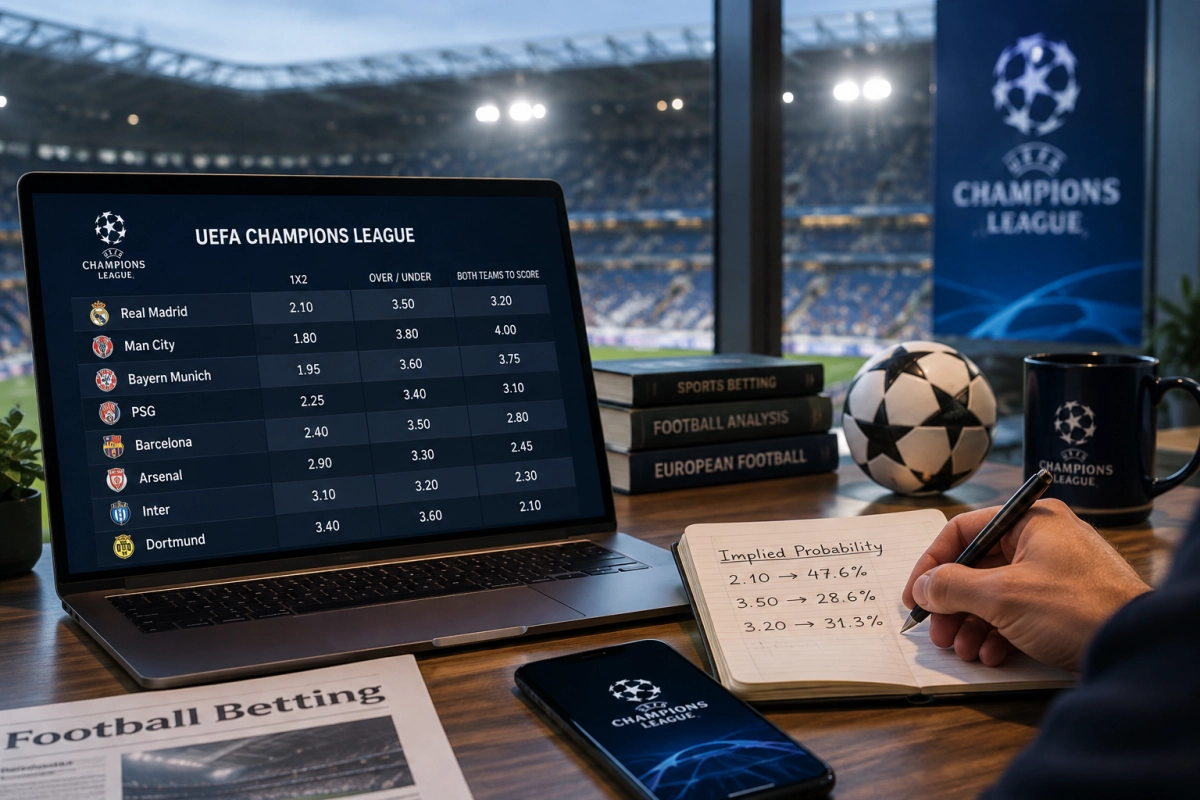
In a three-way match-result market—also called 1X2—you choose a home win, draw or away win. Imagine a match with these illustrative decimal prices:
- Home win: 2.10
- Draw: 3.40
- Away win: 3.60
Convert each price using the formula:
- Home win: 1 ÷ 2.10 × 100 = 47.62%
- Draw: 1 ÷ 3.40 × 100 = 29.41%
- Away win: 1 ÷ 3.60 × 100 = 27.78%
Add the three figures: 47.62% + 29.41% + 27.78% = 104.81%. The amount above 100%—4.81 percentage points—is the market’s overround. It represents the margin built into those prices, rather than a precise forecast of the bookmaker’s eventual profit.
For a rough comparison without that margin, divide each implied probability by the total, then multiply by 100. Here, the adjusted figures are approximately 45.4% for a home win, 28.1% for a draw and 26.5% for an away win. These normalized probabilities add to about 100%. They are a way to interpret this set of prices, not definitive probabilities of the match outcomes.
Keep market definitions consistent when comparing prices
Odds comparison is useful only when you are checking the same selection under the same rules. A home win in the 90-minute 1X2 market is not equivalent to a team qualifying for the next round, which may include extra time or penalties. Likewise, compare over/under goals at the same line, such as over 2.5 goals, and check how each market settles.
Common Champions League markets include match result, both teams to score (BTTS), total goals, double chance and correct score. Each asks a different question, so its price should be assessed separately. In the next part, we’ll apply the same comparison principles to these markets and show what to check before choosing between prices.
Compare BTTS and totals prices as separate two-way markets
Both teams to score (BTTS) and total-goals markets usually offer two opposing selections. For BTTS, those are “yes” and “no”; for an over/under market, they might be over or under 2.5 goals. Convert each price separately, then add the implied probabilities to see how much the pair exceeds 100%.
For example, suppose over 2.5 goals is priced at 1.85 and under 2.5 at 2.00. The implied probabilities are about 54.1% and 50.0%, totalling 104.1%. To normalize this pair, divide each figure by 104.1 and multiply by 100. That gives roughly 52.0% for over and 48.0% for under. As with a 1X2 market, these adjusted figures describe the balance of the prices, not a guaranteed forecast.
Check the exact line before comparing totals. Over 2.5 goals is not the same selection as over 3.5, and a price for BTTS “yes” should be compared with another bookmaker’s BTTS “yes” price—not with an over-goals selection. The markets can be related, but they settle on different conditions.
Interpret double-chance prices according to the outcomes they cover
Double chance combines two 90-minute results: 1X covers a home win or draw, X2 covers a draw or away win, and 12 covers either team winning. Apply the same decimal-odds formula to each price, but remember that the resulting figure refers to the combined selection. If X2 is 1.55, its implied probability is about 64.5%; it is not the implied probability of an away win alone.
Unlike the three outcomes in a 1X2 market, the three double-chance selections overlap. For instance, a draw satisfies both 1X and X2. Their implied probabilities therefore should not be added together to estimate a market total or normalized as if they were mutually exclusive outcomes. Compare one selection with the same selection at other bookmakers, and check that all prices refer to the same match period and settlement rules.
Compare the best available price for an identical selection
Once the market and selection match, compare the decimal odds directly. Suppose one bookmaker offers 2.00 on a home win and another offers 2.10. The prices imply 50.0% and about 47.6%, respectively. The higher price pays more for the same winning selection: a 10-unit stake would return 21 units at 2.10, including the stake, compared with 20 units at 2.00.
This difference does not mean the match has become less likely; it means the bookmakers are offering different prices. Check several operators where available, and note the time of each comparison because odds can change. For a fuller assessment, compare all outcomes in the same market as well: a single attractive price does not show how much margin is built into the complete set of odds. Keep your own probability estimate separate from the bookmaker’s implied figure, and treat any difference as a point to examine rather than proof of value.
Use odds as a tool, not a promise
Champions League prices can change as team news, market activity and other information emerge, so any comparison is only a snapshot. Keep your assessment measured, and remember that no calculation can remove the uncertainty of a match.
If you choose to bet, set a limit you can afford to lose and stick to it. Betting should remain entertainment, not a way to make money or recover losses.
Why implied probability matters in Champions League betting
Champions League betting odds show the price offered for an outcome. Converting that price into an implied probability gives you a clearer way to assess what the odds represent and compare options across bookmakers. It does not tell you what will happen: it is a mathematical reading of the price, not a guarantee or a complete prediction.
This guide focuses on decimal odds, commonly displayed in football betting. The calculation is straightforward:
Implied probability (%) = (1 ÷ decimal odds) × 100
For example, odds of 1.80 imply a probability of about 55.6%: 1 divided by 1.80, then multiplied by 100. At 3.00, the implied probability is 33.3%. Lower decimal odds correspond to higher implied probabilities, but the price alone does not establish whether a bet represents good value.
Bookmaker odds usually include a margin, so the implied probabilities for all outcomes in a market can add up to more than 100%. That excess is called the overround. It helps explain why simply reading each price as a fair, no-margin probability can be misleading.
Calculate the 1X2 overround and adjust for the margin
In a three-way match-result market—also called 1X2—you choose a home win, draw or away win. Imagine a match with these illustrative decimal prices:
- Home win: 2.10
- Draw: 3.40
- Away win: 3.60
Convert each price using the formula:
- Home win: 1 ÷ 2.10 × 100 = 47.62%
- Draw: 1 ÷ 3.40 × 100 = 29.41%
- Away win: 1 ÷ 3.60 × 100 = 27.78%
Add the three figures: 47.62% + 29.41% + 27.78% = 104.81%. The amount above 100%—4.81 percentage points—is the market’s overround. It represents the margin built into those prices, rather than a precise forecast of the bookmaker’s eventual profit.
For a rough comparison without that margin, divide each implied probability by the total, then multiply by 100. Here, the adjusted figures are approximately 45.4% for a home win, 28.1% for a draw and 26.5% for an away win. These normalized probabilities add to about 100%. They are a way to interpret this set of prices, not definitive probabilities of the match outcomes.
Keep market definitions consistent when comparing prices
Odds comparison is useful only when you are checking the same selection under the same rules. A home win in the 90-minute 1X2 market is not equivalent to a team qualifying for the next round, which may include extra time or penalties. Likewise, compare over/under goals at the same line, such as over 2.5 goals, and check how each market settles.
Common Champions League markets include match result, both teams to score (BTTS), total goals, double chance and correct score. Each asks a different question, so its price should be assessed separately. In the next part, we’ll apply the same comparison principles to these markets and show what to check before choosing between prices.
Compare BTTS and totals prices as separate two-way markets
Both teams to score (BTTS) and total-goals markets usually offer two opposing selections. For BTTS, those are “yes” and “no”; for an over/under market, they might be over or under 2.5 goals. Convert each price separately, then add the implied probabilities to see how much the pair exceeds 100%.
For example, suppose over 2.5 goals is priced at 1.85 and under 2.5 at 2.00. The implied probabilities are about 54.1% and 50.0%, totalling 104.1%. To normalize this pair, divide each figure by 104.1 and multiply by 100. That gives roughly 52.0% for over and 48.0% for under. As with a 1X2 market, these adjusted figures describe the balance of the prices, not a guaranteed forecast.
Check the exact line before comparing totals. Over 2.5 goals is not the same selection as over 3.5, and a price for BTTS “yes” should be compared with another bookmaker’s BTTS “yes” price—not with an over-goals selection. The markets can be related, but they settle on different conditions.
Interpret double-chance prices according to the outcomes they cover
Double chance combines two 90-minute results: 1X covers a home win or draw, X2 covers a draw or away win, and 12 covers either team winning. Apply the same decimal-odds formula to each price, but remember that the resulting figure refers to the combined selection. If X2 is 1.55, its implied probability is about 64.5%; it is not the implied probability of an away win alone.
Unlike the three outcomes in a 1X2 market, the three double-chance selections overlap. For instance, a draw satisfies both 1X and X2. Their implied probabilities therefore should not be added together to estimate a market total or normalized as if they were mutually exclusive outcomes. Compare one selection with the same selection at other bookmakers, and check that all prices refer to the same match period and settlement rules.
Compare the best available price for an identical selection
Once the market and selection match, compare the decimal odds directly. Suppose one bookmaker offers 2.00 on a home win and another offers 2.10. The prices imply 50.0% and about 47.6%, respectively. The higher price pays more for the same winning selection: a 10-unit stake would return 21 units at 2.10, including the stake, compared with 20 units at 2.00.
This difference does not mean the match has become less likely; it means the bookmakers are offering different prices. Check several operators where available, and note the time of each comparison because odds can change. For a fuller assessment, compare all outcomes in the same market as well: a single attractive price does not show how much margin is built into the complete set of odds. Keep your own probability estimate separate from the bookmaker’s implied figure, and treat any difference as a point to examine rather than proof of value.
Separate a probability estimate from a value judgment
An implied probability describes what a price represents before accounting for the bookmaker’s margin; it is not an independent assessment of a team’s chances. To judge whether a price appears attractive, you would need a reasoned estimate of the outcome’s likelihood and a comparison with the available odds. That estimate is uncertain, especially in knockout football, where one incident can change a match.
For illustration, if you estimate an outcome at 50% and see decimal odds of 2.10, the price implies about 47.6% before margin adjustments. The gap may prompt further analysis, but it does not prove your estimate is accurate or that the selection will win. Consider how you formed the estimate, whether it uses relevant information and whether the market definition matches.
Questions to ask before drawing conclusions
- Are the odds for the same selection, match period and settlement rules?
- Have you considered the margin across the full market rather than one price alone?
- Could team news or other uncertainty make your estimate unreliable?
Odds can also move between an initial comparison and kickoff. A changed price alters the implied probability, but movement alone does not explain why the market shifted or establish which price is correct. Record the time and source when comparing quotes, and avoid treating a short-term change as a reliable signal. Use the calculation to organize information, not to create certainty where none exists.
Use odds as a tool, not a promise
Champions League prices can change as team news, market activity and other information emerge, so any comparison is only a snapshot. Keep your assessment measured, and remember that no calculation can remove the uncertainty of a match.
If you choose to bet, set a limit you can afford to lose and stick to it. Betting should remain entertainment, not a way to make money or recover losses.